


High-Income Tax Planning Strategies
Tax planning strategies for high-income earners center on five legal categories: maximizing tax-deferred retirement contributions, deploying charitable giving vehicles, optimizing investment structures for capital gains efficiency, leveraging business entity elections, and utilizing estate planning tools that reduce current-year taxable income.
For individuals earning above $500,000 annually, the combined federal and state marginal tax rate can exceed 50% — making proactive, year-round tax planning the single highest-impact financial decision available. At TFA, our in-house CPAs sit in the room with our wealth advisors so your tax strategy and investment strategy work as one coordinated plan, not two disconnected conversations. Here are the specific strategies, income thresholds, and planning vehicles that reduce your tax burden legally and permanently.
Top 5 Strategies: A Quick Summary
High-income earners can reduce taxable income legally through a combination of approaches that work across different areas of their financial life. The following summary provides the framework — each strategy is detailed in subsequent sections.
- Maximize retirement account contributions — $24,500 401(k) limit in 2026, plus catch-up provisions and mega backdoor Roth strategies.
- Deploy charitable giving vehicles — Donor-advised funds, charitable remainder trusts, and qualified charitable distributions for tax-efficient philanthropy.
- Optimize investment structures — Tax-loss harvesting, qualified opportunity zone investments, and 1031 exchanges for real estate.
- Leverage business entity elections — S-Corp election for self-employment tax reduction and qualified business income deductions.
- Implement estate planning tools — Grantor trusts, gifting strategies, and family limited partnerships that reduce current-year taxable income.
Each strategy applies at different income levels and personal circumstances. We coordinate across all five categories through our Personal CFO model to ensure no strategy operates in isolation.
Key Takeaway: The five core tax planning strategies for high-income earners — retirement contributions, charitable vehicles, investment optimization, business entity elections, and estate planning tools — work together to legally reduce taxable income, with the greatest impact when coordinated through a unified tax and wealth plan.
Strategy 1: Retirement Account Maximization
Maximizing tax-deferred and tax-free retirement contributions provides the most accessible tax reduction for high-income earners. The 2026 contribution limits establish the baseline, but advanced strategies extend these benefits significantly.
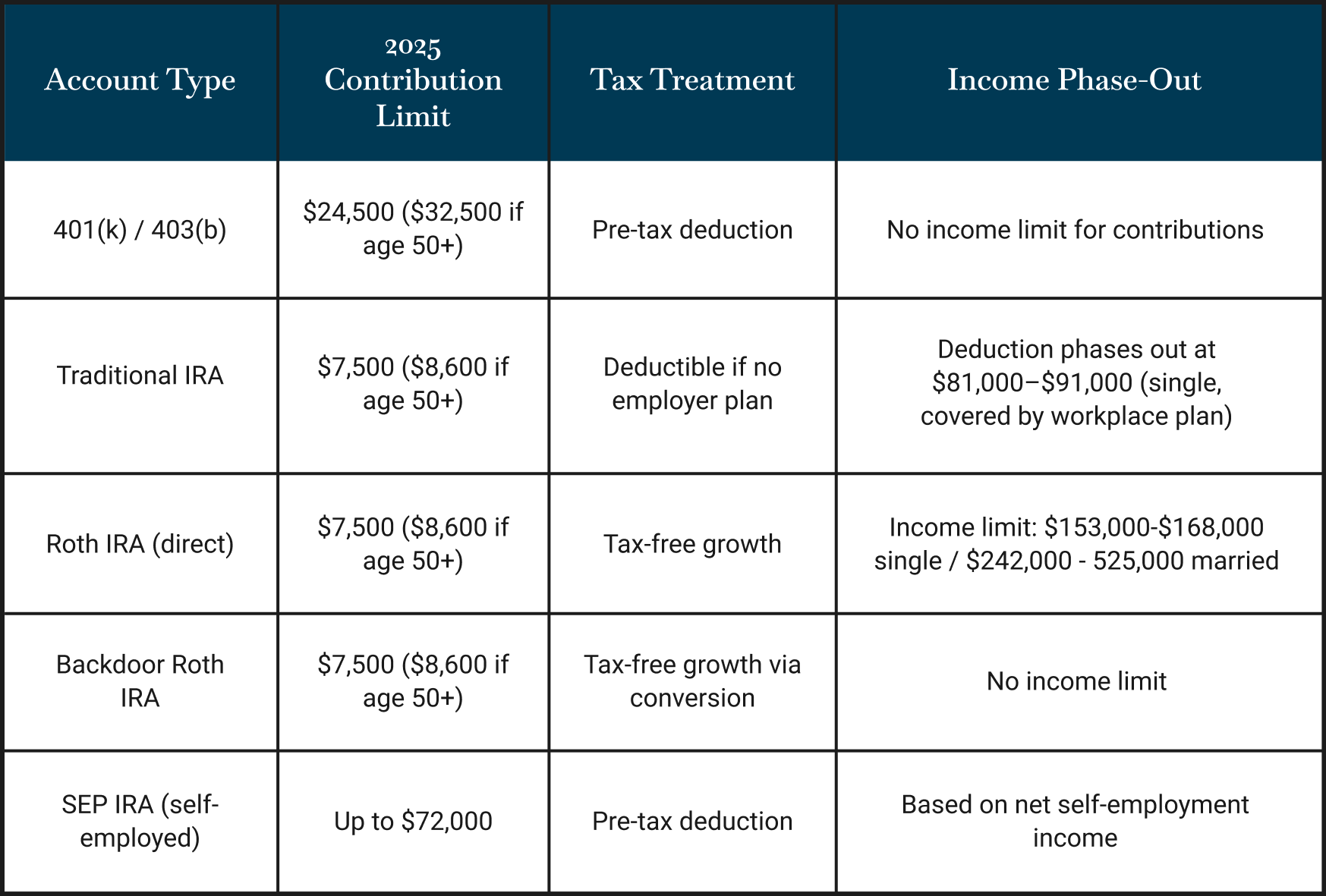
The backdoor Roth IRA strategy allows high-income earners above the direct Roth contribution threshold to contribute to a traditional IRA and immediately convert to Roth. This approach provides tax-free growth and tax-free withdrawals in retirement without income restrictions. The mega backdoor Roth — using after-tax 401(k) contributions with in-plan Roth conversions — can shelter an additional $46,000+ per year for qualifying plans.
Roth conversion strategies deserve particular attention during years with temporarily lower income — sabbaticals, career transitions, or early retirement years before Social Security begins. Converting traditional IRA assets to Roth during these low-income windows reduces the tax cost of conversion and locks in tax-free growth.
Key Takeaway: High-income earners can shelter $23,500 to $72,000+ annually through 401(k), backdoor Roth IRA, and SEP IRA contributions — with the mega backdoor Roth and strategic Roth conversions during low-income years extending tax-free growth opportunities beyond standard contribution limits.
Strategy 2: Charitable Giving Vehicles
Charitable giving vehicles allow high-income earners to convert philanthropic intent into immediate tax deductions while maintaining strategic control over distribution timing. Three structures deliver the greatest tax efficiency for high net worth tax planning.
Donor-Advised Funds (DAFs) accept a lump-sum contribution of cash or appreciated securities, provide an immediate tax deduction in the contribution year, and allow you to distribute grants to charities over time. Contributing highly appreciated stock to a DAF eliminates the capital gains tax you would owe on a sale while generating a deduction at the full market value.
Charitable Remainder Trusts (CRTs) provide an income stream to the donor for a specified period, with the remainder passing to a designated charity. A CRT generates a partial charitable deduction, removes assets from the taxable estate, and defers capital gains tax on contributed appreciated assets. CRTs are particularly effective for high-income earners holding concentrated stock positions or real estate with large embedded gains.
Qualified Charitable Distributions (QCDs) allow individuals aged 70½ or older to direct up to $111,000 per year from an IRA directly to a qualified charity. The distribution satisfies required minimum distributions without adding to taxable income — effectively creating a tax-free charitable transfer.
Key Takeaway: Donor-advised funds provide immediate deductions with flexible grant timing, charitable remainder trusts defer capital gains while generating income, and qualified charitable distributions ($111,000 annual limit) satisfy IRA required minimum distributions tax-free — each vehicle optimizing charitable impact for high-income earners.
Strategy 3: Investment Tax Optimization
Tax-efficient investing strategies reduce the tax drag on portfolio returns by managing the timing, character, and location of investment income. Three approaches deliver the highest impact for high-income earners.
Tax-Loss Harvesting involves selling investments at a loss to offset capital gains realized elsewhere in the portfolio. Net losses up to $3,000 per year can offset ordinary income, with excess losses carrying forward indefinitely. Systematic harvesting across a diversified portfolio can generate $10,000 to $50,000+ in annual tax savings for large portfolios.
Qualified Opportunity Zone (QOZ) Investments allow investors to defer and reduce capital gains by reinvesting gains into designated QOZ funds. Capital gains invested within 180 days of realization receive deferral until 2026 or disposition, with a permanent 10% exclusion of the deferred gain for investments held 5+ years and full exclusion of new gains on QOZ investments held 10+ years.
1031 Exchanges permit real estate investors to defer capital gains taxes indefinitely by reinvesting sale proceeds into like-kind replacement property within 180 days. For high-income earners with real estate portfolios, sequential 1031 exchanges can defer gains across decades, with a step-up in basis at death eliminating the deferred tax permanently.
Key Takeaway: Tax-loss harvesting offsets up to $3,000 of ordinary income annually plus unlimited capital gains, qualified opportunity zone investments provide 10% gain exclusion at 5 years and full new-gain exclusion at 10 years, and 1031 exchanges defer real estate capital gains indefinitely with potential permanent elimination at death.
Strategy 4: Business Entity Tax Elections
Business entity elections — particularly the S-Corp election — offer self-employed high-income earners a legal mechanism to reduce self-employment taxes by splitting income between reasonable compensation (subject to FICA) and distributions (not subject to FICA).
An S-Corp election allows a business owner earning $400,000 in net business income to pay a reasonable salary of $175,000 (subject to 15.3% self-employment tax on the first $184,500 and 2.9% Medicare on the remainder) while distributing the remaining $225,000 as S-Corp distributions exempt from FICA taxes. The self-employment tax savings alone can exceed $15,000 to $25,000 annually.
The qualified business income (QBI) deduction under Section 199A allows eligible business owners to deduct up to 20% of qualified business income, subject to income thresholds and specified service trade or business (SSTB) phase-out rules. For 2026, the SSTB phase-out begins at $197,300 for single filers and $394,600 for married filing jointly.
Business owners should also evaluate the Alternative Minimum Tax (AMT) implications of entity elections and deduction strategies. The AMT exemption for 2026 is $88,100 for single filers and $137,000 for married filing jointly — high-income earners with significant deductions, state tax payments, or incentive stock option exercises should model AMT exposure before implementing strategies.
Key Takeaway: S-Corp election can save self-employed high-income earners $15,000 to $25,000+ annually in self-employment taxes by splitting income between reasonable compensation and FICA-exempt distributions, while the Section 199A QBI deduction provides up to 20% off qualified business income subject to income-based phase-outs.
Strategy 5: Estate Planning as Current-Year Tax Reduction
Estate planning tools reduce current-year taxable income while simultaneously transferring wealth outside your taxable estate. For high-income earners with estates approaching the federal estate tax exemption ($15,000,000 per individual in 2026), these strategies deliver dual benefits.
Grantor Retained Annuity Trusts (GRATs) transfer future asset appreciation to beneficiaries with minimal or zero gift tax cost. The grantor contributes assets to the trust, receives annuity payments back over a fixed term, and any appreciation above the IRS interest rate passes to beneficiaries tax-free.
Annual gifting of up to $19,000 per recipient ($38,000 for married couples) removes assets from the taxable estate without using any lifetime exemption. For high-income earners with multiple children and grandchildren, annual gifting programs can transfer substantial wealth over time.
Family Limited Partnerships (FLPs) allow parents to transfer business or investment assets to the next generation at a discounted value, leveraging lack-of-marketability and minority-interest discounts of 20% to 35% on the transferred assets' appraised value.
Key Takeaway: Estate planning tools including GRATs, annual gifting ($19,000 per recipient in 2026), and family limited partnerships with 20% to 35% valuation discounts serve as current-year tax reduction strategies while transferring wealth outside the $15,000,000 federal estate tax exemption.
Frequently Asked Questions
How do high-income earners reduce taxes?
High-income earners reduce taxes through five coordinated strategies: maximizing retirement contributions (up to $69,000+ annually), deploying charitable giving vehicles, optimizing investment structures for capital gains efficiency, leveraging S-Corp elections for self-employment tax savings, and implementing estate planning tools. We coordinate all five through our Personal CFO model.
What is the best tax strategy for someone making over $500K?
The optimal strategy depends on income composition. W-2 earners benefit most from maximizing 401(k) and backdoor Roth contributions plus tax-loss harvesting. Self-employed earners add S-Corp election savings. Business owners with appreciated assets benefit from charitable remainder trusts and 1031 exchanges. Schedule a Consultation to build a coordinated plan.
Can you contribute to a Roth IRA with a high income?
Direct Roth IRA contributions phase out above $153,000-$168,000 (single) and $242,000-$252,000 (married filing jointly) in 2026. The backdoor Roth IRA strategy bypasses this limit by contributing to a traditional IRA and immediately converting to Roth. The mega backdoor Roth adds another $46,000+ through after-tax 401(k) contributions.
What are legal tax loopholes for the wealthy?
"Loopholes" is a misnomer — these are congressionally intended provisions. Backdoor Roth IRAs, qualified opportunity zone investments, 1031 exchanges, S-Corp elections, charitable remainder trusts, and family limited partnerships are all provisions explicitly designed within the tax code. Proper utilization requires coordinated planning across tax and wealth management.
How do business owners reduce their tax burden?
Business owners reduce taxes through S-Corp election ($15,000 to $25,000+ in annual FICA savings), SEP IRA contributions (up to $72,000), the QBI deduction (up to 20% of qualified income), retirement plan design, and strategic timing of income and deductions across tax years.
Move From Tax Season to Opportunity Season
Effective tax planning strategies for high-income earners require year-round coordination between your tax strategy and your wealth strategy — not a once-a-year filing exercise. The strategies outlined above are most powerful when implemented proactively, monitored quarterly, and adjusted as your income, investments, and life circumstances evolve.
At TFA, we reject the "see you in April" approach. Our in-house CPAs and wealth advisors work as your Personal CFO, coordinating retirement contributions, charitable vehicles, investment positioning, entity elections, and estate planning into a single, unified strategy. Schedule a Consultation to replace "The April Surprise" with a clear, coordinated roadmap.
Disclaimer: TFA provides financial advisory services. This content is for educational purposes and does not constitute tax or legal advice. Consult your tax advisor regarding your specific situation. Securities and advisory services offered through LPL Financial, a registered investment advisor, Member FINRA/SIPC.


Let's Start Planning
It starts right here. Our experts are standing by and ready to empower you to build the future you want.
- Schedule a Free Consultation
- Discover Custom Solutions
- Start Building Your Competitive Advantage